Fireweed: Why It’s Showing Up in Lawns Across the South and Mid-South This Year
 May 19, 2015
1 min read
May 19, 2015
1 min read
Key Takeaways
- American burnweed (Erechtites hieraciifolius) also called fireweed, burnweed, butterweed, or pilewort is a native North American annual weed, not an invasive species, common across the Southeast, Arkansas, and Oklahoma.
- It’s a different plant from the pink-flowered “fireweed” (Chamerion angustifolium) associated with pollen allergies out west. There’s no strong evidence American burnweed itself triggers allergies, though handling it can mildly irritate sensitive skin.
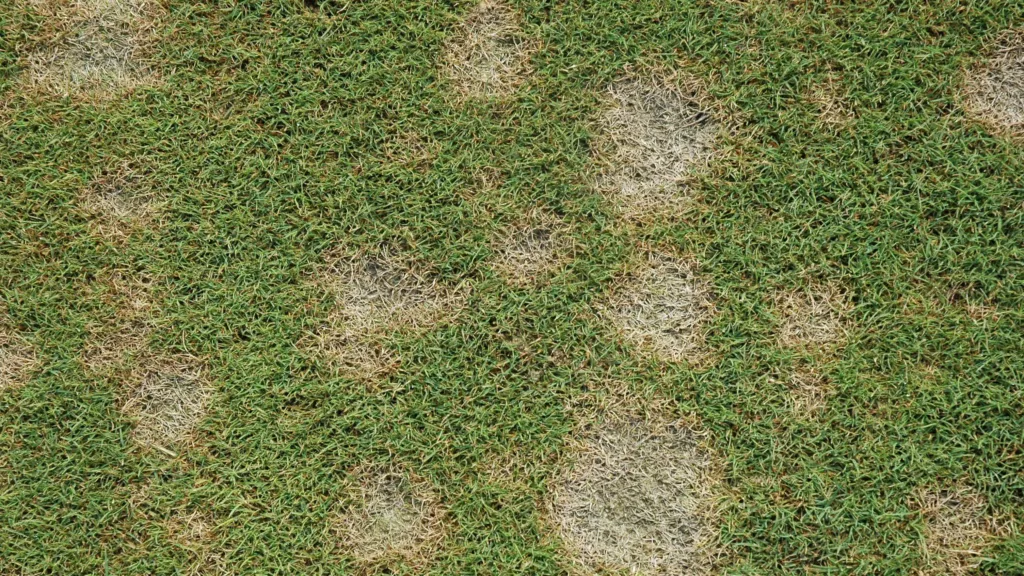
- A dry winter followed by heavy spring rain across the South and Mid-South left lawns thin and bare, then wet, which is exactly the conditions this fast-growing weed needs to spread.
- Its wind-dispersed seed lands on top of the soil instead of below it, so pre-emergent herbicides mostly miss it. Control depends on early hand-pulling or a correctly timed post-emergent herbicide application.
- Preventing it long-term is a turf-density problem, not a one-time spray: consistent mowing, aeration, overseeding, and a recurring professional weed control program close the bare ground it needs to take hold.
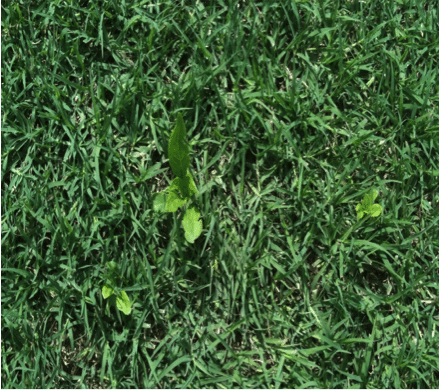
If you’ve noticed a tall, fast-growing weed with feathery white seed puffs taking over the bare patches in your lawn this year, it’s most likely American burnweed, a native, non-invasive, fast-moving, and opportunistic weed that thrives on this year’s weather. The pattern of drought-then-rain across the South and Mid-South created optimal conditions for fireweed proliferation. Getting rid of it means treating what’s up now, correctly and on time. Keeping fireweed from coming back means building a lawn dense enough to keep it from getting a foothold in the first place.
What Is American Burnweed?
Fairway Lawns technicians have been fielding more calls about this one across the South and Mid-South this spring and summer. It goes by a handful of names: American burnweed, fireweed, burnweed, butterweed, pilewort, and white fireweed. The plant’s scientific name is Erechtites hieraciifolius. It’s a member of the aster (daisy) family, and it’s an annual, which means each plant completes its life cycle (germinate, grow, flower, seed, die) in a single season.
One naming mix-up worth clearing up before we go further: this is not to be confused with another plant also commonly referred to as “fireweed” – Chamerion angustifolium, the tall plant with showy pink-purple flowers found in the western and northern U.S.
American burnweed is native to eastern North America, not an import. It’s what botanists call a pioneer species because it’s a plant built to move fast into bare, disturbed ground and get established before other vegetation catches up (NC State Extension Gardener Plant Toolbox; bplant.org). Its native range runs from the eastern provinces of Canada down through most of the eastern, central, and southern United States. This is why it shows up not just in the Southeast, but in Arkansas, Oklahoma, and well beyond (U.S. Fish & Wildlife Service).
Is American Burnweed Invasive?
No, not in the U.S. American burnweed is native to the Southeast, the Mid-South, and most of eastern North America. It does behave as an introduced, sometimes weedy plant in parts of Asia and elsewhere overseas, but here at home it’s simply a native plant doing what native pioneer species do: colonizing bare ground quickly (Invasive Plant Atlas of the United States).
That said, “not invasive” doesn’t mean “not a problem in your yard.” It’s a native opportunist, not a foreign threat, but it still competes with turfgrass wherever it takes hold. In the wild, it favors roadsides, ditches, disturbed soil, and the margins of lakes and rivers – all habitats that look a lot like the bare, thin, or recently disturbed patches many lawns had this year.
Does American Burnweed Cause Allergies?
There’s no strong evidence that American burnweed itself is a common allergen, or that sitting near it or having a lot of it in your yard triggers seasonal allergy symptoms the way ragweed or grass pollen does. Extension experts specifically note they haven’t documented allergic reactions tied to this plant (Ask Extension).
Much of what turns up online about “fireweed allergy” is actually about that other plant, Chamerion angustifolium, which has its own pollen profile and is a separate species entirely. If you’ve seen allergy information tied to the name “fireweed,” there’s a good chance it wasn’t describing the weed in your yard.
What can happen with American burnweed is mild skin irritation from handling or brushing against the foliage, especially if you have sensitive skin. That’s contact irritation, not a documented allergic reaction. The plant also gives off an unpleasant odor when its leaves are crushed or mowed (Clemson HGIC), which is unpleasant but not a health signal. If you’re pulling it by hand, gloves and long sleeves are a reasonable precaution.
Why Is American Burnweed Spreading So Fast This Spring and Summer?
This isn’t a brand-new plant. It’s a native species that’s been a known, gradually increasing lawn and turf issue since it started showing up more regularly in the late 1980s. What’s different this year is the weather setup that primed lawns for it.
Much of the Southeast, Arkansas, and Oklahoma ran well below normal rainfall from late 2025 into early 2026. Arkansas logged one of its driest Marches on record with total precipitation for the nine months through April running 13.7 inches below average. Roughly 99% of Oklahoma was in drought as of late March (Drought.gov: Arkansas, Louisiana, and Mississippi update; Oklahoma Farm Report). That left lawns thin, stressed, and bare in patches. Then multi-day rain systems moved through in May, bringing several inches of rain to eastern Oklahoma, southern Arkansas, and much of the Southeast in a short window (Drought.gov: Southern Plains update; AccuWeather 2026 Spring Forecast.
Bare, disturbed, drought-stressed turf followed by a burst of moisture is exactly the seedbed this weed is built for. American burnweed produces dandelion-like “parachute” seed that rides the wind and lands on top of the soil surface rather than being buried. This is precisely why standard pre-emergent herbicides largely miss it (Virginia Tech Turfgrass).
Lawns on a biweekly or inconsistent mowing schedule, or warm-season lawns that hadn’t fully thickened up yet, gave the weed the open canopy it needed. Also, because it germinates in waves through the whole growing season rather than one spring flush, new plants keep showing up into fall. This can make the weed seem indestructible because it keeps coming back even after you’ve dealt with a batch.
A note for Fairway Lawns’ clients: the documentation of American burnweed as an established turf problem is strongest for the Southeast and for Arkansas and Tennessee specifically (University of Arkansas Extension; Mid South Turf Professionals). Oklahoma falls within the plant’s native range and experienced the same drought-then-rain pattern this year, so the same widespread growth applies there.
Is American Burnweed Bad for Your Lawn?
Functionally, yes, even though it’s not toxic or invasive. It grows tall fast (a couple of feet in a mowed lawn, taller if left uncut) and shades out and out-competes turfgrass for light, water, and nutrients wherever it gains a hold in your yard.
It’s worth thinking of it as more a symptom than a root cause. Its presence is a strong signal that the turf underneath has issues. Treating the weed without addressing turf density just invites it to come right back. Since its seed is so easily wind-dispersed, a single untreated patch can reseed itself and spread to neighboring lawns quickly. Cosmetically, its tall, leggy growth stands out against mowed turf and can make an otherwise healthy-looking lawn appear neglected.
How Do You Spot American Burnweed in Your Yard?
American burnweed is an upright annual, typically a couple of feet tall in a mowed lawn. It can grow much taller if left uncut. The weed also possesses a hollow, ridged stem that branches near the top. The leaves are narrow, elongated, and lance-shaped with jagged, serrated edges, and they give off an unpleasant smell when crushed or mowed.
The flowers themselves aren’t showy. They’re small, cylindrical, greenish-white to pale flower heads clustered at the top of the plant, easy to overlook until they go to seed. The real giveaway are the fluffy, white, dandelion-like seed puffs that appear as the plant matures. That’s usually what catches a homeowner’s eye first.
Look for it in bare or thin spots, along the edges of beds, in areas that were recently disturbed by digging, construction, erosion, or drought damage, and in sections of lawn that missed a mowing cycle or two.
How Do You Get Rid of American Burnweed?
For small infestations, hand-pull while the plant is young and before it flowers or sets seed. Its roots are shallow, and pulling is easiest right after rain when the soil is soft. If a plant already has seed heads, bag it rather than composting it, so you’re not spreading more seed around the yard. It often spreads so quickly that pulling fireweed manually isn’t an efficient option.
For established or larger infestations, a post-emergent broadleaf herbicide is the more reliable solution. It works best when applied while the weed is small and actively growing and before it reaches the bud or bloom stage. Effective active ingredients commonly include 2,4-D and triclopyr, often combined with dicamba, MCPP/MCPA, carfentrazone, or sulfentrazone in three-way broadleaf mixes (Virginia Tech Turfgrass; Advanced Turf Solutions).
Because it germinates in waves through the season, one application usually isn’t the end of it. Repeated, correctly timed treatments are typically needed to catch new flushes as they emerge. Timing is essential, so don’t wait until the fluffy seed heads have appeared because mowing or disturbing a mature plant at that stage can actually help spread its seed across the yard (Landscape Management).
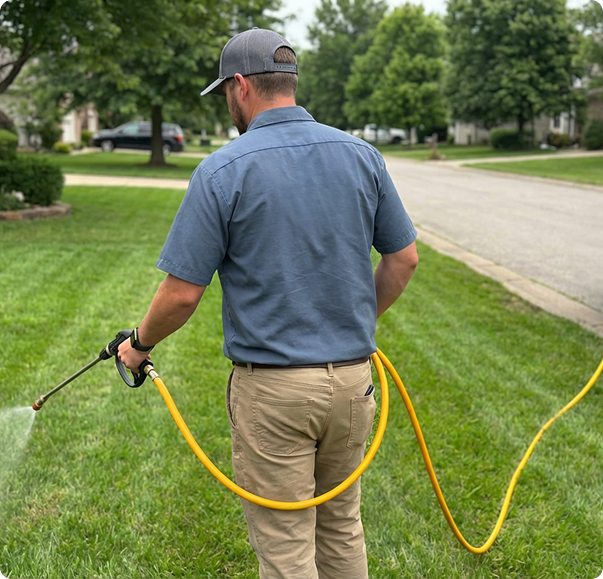
This is often where DIY efforts fall short. Matching the right herbicide to the plant’s growth stage and repeating it correctly through the season takes more attention than most homeowners have time for. It’s exactly the kind of recurring, professional touch a Fairway Lawns treatment program is built around.
How Do You Prevent American Burnweed From Coming Back?
Pre-emergent herbicides have limited effect on this weed, because its seed germinates on the soil surface rather than needing to be buried. Prevention is mostly a turf-health problem, not a single product you can apply once.
The most effective long-term approach is building enough turf density so there’s no bare ground left for it to colonize: consistent weekly mowing at the proper height with a sharp blade, liquid aeration to break up thatch and soil compaction, and overseeding thin or dormant warm-season areas (Virginia Tech Turfgrass). Address disturbed spots directly. Reseed or add fresh sod to bare patches promptly after digging, drought damage, or erosion, before the next windblown seed finds them. Keeping the lawn on a consistent fertilization and mowing program through the growing season helps turf out-compete new germination on its own.
Because American burnweed germinates continuously rather than in one flush, ongoing professional weed control matters more here than for many other weeds. A recurring program catches new growth before it matures and reseeds, rather than treating it as a one-time cleanup.
How Can Fairway Lawns Help Control Fireweed?
American burnweed responds best to a program, not a single fix. Fairway Lawns’ recurring lawn treatment plans combine seasonally-timed weed control with the fertilization and lawn aeration that builds the dense turf this weed struggles to break into.
If you’re not sure whether what’s in your yard is American burnweed or a look-alike, a Fairway Lawns technician can confirm it during a free lawn evaluation and recommend a treatment plan suited to your specific lawn. (Insert link to Fairway Lawns’ free lawn evaluation / quote request page.)