Quick Summary
|
Table of Contents
Dollar Spot · Brown Patch · Pythium Blight · Take-All Root Rot · Fairy Ring
White Grubs · Fire Ants · Chinch Bugs · Armyworms · Mole Crickets
- Non-Pest, Non-Disease Causes of Brown Spots
- How to Identify What Is Causing Your Brown Spots
- How Fairway Lawns Treats Brown Spots
- Why a Professional Service Is the Right Choice
- Frequently Asked Questions
1. Why Brown Spots Happen in Southern Lawns
If you live in the South, you already know how demanding the climate can be on a lawn. Long stretches of heat and humidity, brief dry spells that bake exposed soil, and warm nights that never seem to cool off the way they should. It all adds up to an environment where lawns are under constant pressure.
Brown spots are one of the most common and frustrating things a homeowner notices. The patch shows up almost overnight. The color drains, the grass lies flat or pulls up without much resistance, and the spreading pattern never quite makes sense. You water more and nothing changes. You fertilize and it still looks the same.
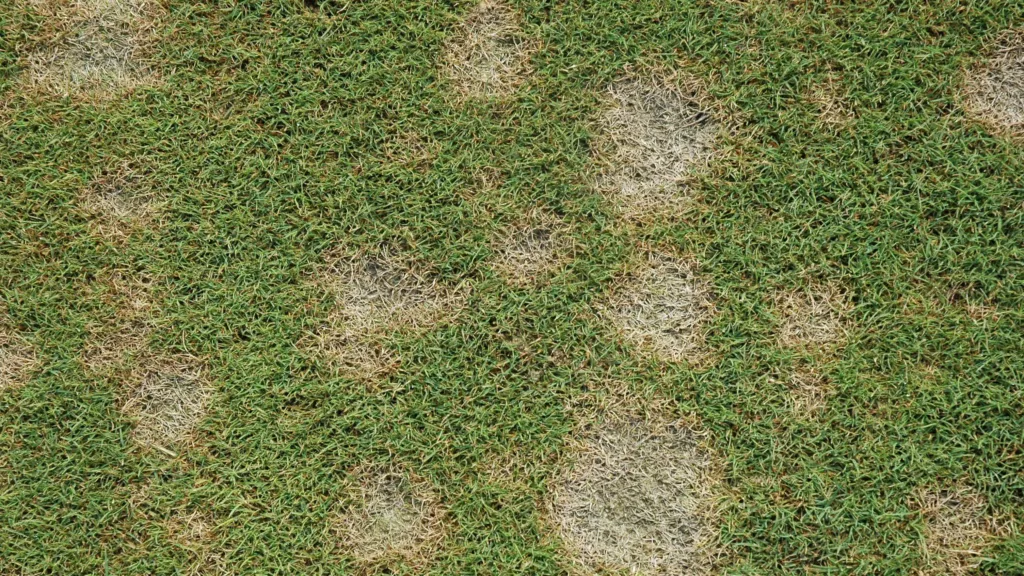
The reason brown spots are so difficult to fix without professional help is simple: there is no single cause. A perfectly circular, tan-colored patch with a darker border is telling you something very different than a brown area that looks like someone doused it with bleach, or a spongy section that gives under your feet and smells faintly of something wrong underneath.
Southern lawns are uniquely vulnerable because the region’s warm-season grasses (Bermudagrass, Zoysia, St. Augustine, and Centipede) create dense canopies that hold moisture close to the soil surface. That moisture is fuel for fungal diseases and a welcome mat for turf-damaging insects.
Getting to the bottom of a brown spot problem starts with understanding the categories of causes: disease, pests, and cultural/environmental stressors. Once you narrow down which category you are dealing with, the path to a solution becomes much clearer.
2. Lawn Diseases That Cause Brown Spots
Fungal diseases are among the most common causes of brown spots in Southern lawns, and they tend to thrive in exactly the conditions that define a Southern spring, summer, or fall: warm soil, heavy moisture, humid overnight air, and dense turf.
Dollar Spot
What it looks like: Small, straw-colored spots roughly the size of a silver dollar, often bleached at the tips. When multiple spots merge together, they can cover significant patches of turf. Look for a white, cobweb-like fungal growth across the grass blades in the early morning while dew is still present.
Why it happens in the South: Dollar spot is especially active in late spring and fall when nighttime temperatures stay above 50°F and the lawn is receiving inconsistent irrigation. It thrives when turf is low in nitrogen or when the thatch layer is thick.
What it affects: Bermudagrass and Zoysia are particularly susceptible, and Centipede and St. Augustine can also be affected.
How to fix it: A lawn disease control treatment combined with a proper fertilization program that addresses nitrogen deficiency is the most effective approach. Improving irrigation timing by watering deeply in the morning rather than late at night also reduces recurrence.
Brown Patch (and Large Patch)
What it looks like: Irregular, roughly circular patches that can range from a few inches to several feet wide. The affected grass often has a tan or light brown center with a darker ring around the outer edge, sometimes called a “smoke ring.” Blades in the affected zone may be matted down.
Why it happens in the South: Brown patch is caused by the fungus Rhizoctonia solani. On warm-season grasses, the disease is often called large patch, and it is most active in spring and fall when temperatures range from about 60°F to 75°F and the turf stays wet for long periods. In tall fescue lawns in the upper South, brown patch peaks during hot, humid summer nights when temperatures stay above 70°F.
What it affects: St. Augustine, Zoysia, and Centipede are the most vulnerable warm-season grasses, while tall fescue is the main cool-season target. Bermudagrass is affected less often. Brown patch can spread rapidly when the turf stays wet overnight.
How to fix it: Fungicide applications, improved drainage, and reduced late-afternoon or evening watering can all help. Fairway Lawns’ services include targeted disease control treatments tailored to the grass type and disease present.
Pythium Blight
What it looks like: Greasy, dark, water-soaked patches that appear almost overnight and collapse quickly. The infected areas turn tan or brown rapidly. A white, cottony fungal growth is often visible in the early morning hours. Pythium blight can move quickly across the lawn, sometimes following drainage patterns.
Why it happens in the South: This disease is most dangerous when nighttime temperatures stay above 70°F with very high humidity, which are peak conditions across much of the South from late June through August.
What it affects: Most commonly affects fescue and ryegrass, including ryegrass overseeded into Bermuda lawns for winter color, though it can impact warm-season grasses under severe conditions.
How to fix it: Pythium is one of the more aggressive lawn diseases and typically requires prompt fungicide treatment combined with improved drainage and reduced irrigation. Left untreated, it can kill large areas of turf in days.
Take-All Root Rot
What it looks like: Yellowing that slowly transitions to brown, with affected grass wilting and thinning out. Unlike dollar spot or brown patch, take-all root rot attacks the root system rather than the blades, so the turf pulls up easily with minimal resistance. Roots appear short, dark, and rotted.
Why it happens in the South: Take-all root rot (Gaeumannomyces graminis) thrives in poorly draining soils with high moisture and is more common in soils with a high pH. It is frequently seen in St. Augustine lawns in Florida, Georgia, and South Carolina after periods of heavy rainfall.
What it affects: St. Augustine is the primary target, though Bermudagrass and Centipede can also be affected.
How to fix it: Soil amendments, improved drainage, and a properly timed fungicide program are central to treatment. Our soil testing and analysis services help identify whether soil conditions, including pH, are contributing to the problem.
Fairy Ring
What it looks like: Circular or arc-shaped rings of darker, lush green grass surrounded by zones of brown, dying turf. Mushrooms may appear along the ring. The dying grass inside or adjacent to the ring often looks scorched.
Why it happens in the South: Fairy rings are caused by soil-dwelling fungi that consume organic matter (buried wood, old tree roots, or heavy thatch deposits) and release nitrogen as a byproduct. The result is an uneven growth pattern that damages the surrounding turf.
How to fix it: Core aeration and dethatching can reduce the organic matter fueling the fungus. In persistent cases, fungicide applications targeting the soil layer may be necessary. Fairway Lawns’ liquid aeration treatment with Sup-R-Soil helps break up compacted soil and improves water movement, reducing the dry, water-repellent soil conditions that make fairy ring damage worse.
3. Lawn Pests That Cause Brown Spots
Several insects common to the South attack lawns directly, either by feeding on the blades above the soil surface or destroying the root system below it. In both cases, the result looks similar: brown, dying grass that does not respond to water or fertilizer because the damage is already done at the plant level.
White Grubs
What they are: The larval stage of several beetles, including Japanese beetles, June beetles, and chafers. Grubs are C-shaped, white-bodied, and live in the top one to three inches of soil, feeding on grass roots from late summer through fall and again in spring.
What the damage looks like: Irregular brown patches that expand over time. The turf pulls up like a loose piece of carpet with little or no resistance because the roots have been eaten through. You may notice spongy areas or increased activity from birds, raccoons, moles, or armadillos digging into the lawn to find the grubs.
Why it’s a particular issue in the South: Warm soil temperatures accelerate grub development, and well-irrigated lawns attract egg-laying beetles in midsummer. Grub damage tends to peak in late summer through October across Tennessee, Arkansas, Georgia, and Alabama.
How to fix it: Grub control applications timed to the insect’s life cycle are the most effective treatment. Applications made too early or too late lose efficacy. Fairway Lawns’ special lawn services include targeted grub control as part of a broader lawn health assessment.
Fire Ants
What they are: One of the most recognized and most painful pests in the South. Fire ants (Solenopsis invicta) build large mounds and create a hazard for people, pets, and lawn equipment.
What the damage looks like: The mounds themselves kill the grass immediately beneath them by smothering roots and creating hard-packed soil barriers. Around larger mounds, activity from foraging ants can stress and thin nearby turf. Fire ant mounds are most prominent in open, sunny areas.
Why it’s a particular issue in the South: Fire ants are an invasive species from South America that has spread across the southeastern United States, where they have few natural enemies to keep populations in check. Alabama, Arkansas, Florida, Georgia, Oklahoma, and South Carolina all deal with heavy fire ant pressure. New mounds often appear quickly after rain.
How to fix it: Both broadcast bait applications and individual mound treatments have roles in a comprehensive fire ant management program. Fairway Lawns’ special lawn services address fire ant control as a targeted treatment when infestations are identified.
Chinch Bugs
What they are: Tiny insects (adults reach about 1/6 of an inch) that feed by piercing grass blades and extracting plant fluids while simultaneously injecting a toxin that prevents the grass from transporting water.
What the damage looks like: Brown patches that appear in sunny, hot areas of the lawn first, typically near driveways, sidewalks, and south- or west-facing slopes. The affected grass looks like it is drought-stressed (brown, dry, and brittle) but will not recover with irrigation because the damage is toxin-related, not water-related.
Why it’s a particular issue in the South: Chinch bugs thrive in hot, dry conditions and are one of the leading causes of summer lawn damage in Florida and Georgia. St. Augustine grass is their preferred host.
How to do a chinch bug check: Part the grass at the edge of a damaged area and look for small, dark insects with white wing markings moving through the thatch layer. You can also use the “coffee can method”: remove both ends of a coffee can, press it into the soil at the edge of a damaged area, fill it with water, and watch for insects floating to the surface over five to ten minutes.
How to fix it: Targeted insecticide applications to the affected areas and surrounding healthy turf can stop active populations. Re-sodding or plugging may be necessary where turf has been killed, since St. Augustine is not grown from seed. Fairway Lawns’ services include insect identification and targeted control.
Armyworms
What they are: The caterpillar stage of a moth, armyworms (Spodoptera frugiperda) feed in large groups and can move across a lawn and between neighboring yards surprisingly quickly, consuming grass blades at the soil surface.
What the damage looks like: Large areas of lawn that appear closely cropped or scalped, with grass blades chewed off at or near the soil line. Damage can progress from a small patch to a half-acre within a week during a heavy outbreak. Birds feeding heavily on the lawn are often a sign armyworms are present below.
Why it’s a particular issue in the South: Fall armyworm outbreaks are a recurring concern across Alabama, Arkansas, Georgia, Tennessee, and Oklahoma during late summer and early fall. Bermudagrass, ryegrass, and fescue are all common targets.
How to fix it: Armyworm populations need to be identified and treated quickly because delay allows the larvae to grow larger and harder to control. Fairway Lawns’ lawn monitoring and lawn care services can identify early-stage infestations before they escalate.
Mole Crickets
What they are: Burrowing insects with paddle-like front legs designed for digging. Mole crickets tunnel through the soil near the surface, severing grass roots and disrupting soil structure.
What the damage looks like: Raised, tunnel-like tracks visible in the soil surface. Grass in affected areas wilts, browns, and dies due to root separation. The soil around the tunnels may feel loose or spongy. Damage is often worse during dry periods when the insects tunnel deeper seeking moisture.
Why it’s a particular issue in the South: Mole crickets are a significant pest in the coastal Southeast, with the highest populations found in Florida, Georgia, and South Carolina. Bahiagrass and Bermudagrass are most commonly damaged.
How to fix it: Mole cricket control is most effective when bait or insecticide applications are timed to target young nymphs in late spring and early summer. Fairway Lawns’ pest control services address mole crickets as part of a site-specific pest management plan.
4. Non-Pest, Non-Disease Causes of Brown Spots
Not every brown spot traces back to a fungal pathogen or an insect. Several cultural and environmental factors create damage that looks nearly identical to a disease or pest problem and leads homeowners to treat the wrong thing.
Drought Stress and Inconsistent Watering
Southern summers can push soil moisture to critical lows within days. Bermudagrass and Zoysia are reasonably drought-tolerant, but St. Augustine and Centipede respond visibly to moisture stress within a week of inadequate irrigation. Drought-stressed grass typically browns uniformly across the highest and sunniest areas first, rather than in circular patches. Most lawns need about 1 inch of water per week from rain or irrigation during the growing season.
Overwatering and Poor Drainage
Too much water, especially when combined with compacted soil that cannot absorb it, keeps the root zone saturated, starves roots of oxygen, and creates exactly the warm, wet conditions that fungal diseases love. If brown areas are concentrated in low spots or near downspouts, drainage is likely part of the problem.
Fairway Lawns’ Sup-R-Soil liquid aeration helps loosen compacted soil and improve the way water moves through the root zone, reducing both drought stress and overwatering damage.
Fertilizer Burn
Over-application of nitrogen-heavy fertilizer, or applying it to a dry lawn, can burn grass and create brown streaks or patches that follow the pattern of the spreader. Burn damage is usually sharp-edged and appears within a few days of a fertilizer application.
Read more about proper fertilization timing and rates in our guide: When to Fertilize Your Lawn + Complete Seasonal Schedule.
Dog Urine
Dog urine contains concentrated nitrogen and salts that burn grass quickly. Damage from dog urine typically appears as small, roughly circular brown spots with a ring of darker green grass at the outer edge (where the urine was most diluted). If the pattern is consistent in the same areas and you have dogs, this is likely the cause.
Compacted Soil
Dense, compacted clay soil, which is common throughout much of the mid-south and southeastern regions, restricts root depth, limits water infiltration, and creates conditions where grass struggles even under normal care. Brown areas caused by compaction tend to be diffuse rather than sharply defined. Lawn aeration addresses this directly.
Scalping or Mowing Too Low
Cutting warm-season grass below its optimal height removes too much of the leaf blade and exposes the crown to direct sun and heat stress. The result is a brown, stubble-like appearance across larger areas. Bermudagrass is most often affected because homeowners see it respond well to lower cutting heights, but only up to a point. Use these general mowing heights as a guide:
| Grass Type | Recommended Mowing Height |
|---|---|
| Bermudagrass | 1 to 2 inches |
| Zoysia | 1 to 2.5 inches |
| Centipede | 1 to 2 inches |
| St. Augustine | 2.5 to 4 inches |
| Tall fescue | 3 to 4 inches |
Soil pH Imbalance
When soil pH drifts too far in either direction, grass cannot absorb nutrients efficiently, even when fertilizer is being applied on schedule. Yellowing and browning that does not respond to feeding may be a soil chemistry problem, not a fertility problem. Fairway Lawns’ soil testing and analysis service identifies pH and nutrient imbalances and recommends corrective treatments.
5. How to Identify What Is Causing Your Brown Spots
Because the treatment for brown patch is completely different from the treatment for grubs, which is different from the fix for drought stress, getting the identification right is the most critical step. Here is a practical diagnostic approach:
Step 1: Look at the Pattern
| Pattern | Likely Cause |
|---|---|
| Perfectly circular or oval patches | Fungal disease (dollar spot, brown patch) |
| Irregular, expanding patches | Armyworms, chinch bugs, grubs |
| Matching the spreader path | Fertilizer burn |
| Following low spots or wet areas | Drainage issues, Pythium blight |
| Small circles with green outer ring | Dog urine |
| Large rings or arcs of dark green grass, sometimes with mushrooms | Fairy ring |
| Spongy, loose, pulls up easily | Grubs (root damage) |
| Raised tunnels in soil | Mole crickets |
| Mounds present | Fire ants |
| Uniform browning in sunny areas | Drought stress, chinch bugs |
Step 2: Examine the Grass Blades
Pick several blades from the edge of the brown area (not the center, since the active zone is always at the margin). Look for:
- Lesions with dark borders and tan centers → fungal disease
- Chewed-off or jagged blade edges at soil line → armyworms
- Blades that are wilted or shriveled but not chewed → chinch bug toxin
- Normal-looking blades, but the plant pulls up easily → grub root damage
Step 3: Check the Soil
Push a screwdriver six inches into the soil in the brown area. If it goes in easily, moisture is adequate. If it meets significant resistance, compaction or drought is a factor. Dig down two to three inches and look for grubs (C-shaped, white larvae). Check for visible tunneling channels, which are a sign of mole crickets.
Step 4: Consider the Timing
| When It Appears | Most Likely Cause |
|---|---|
| Spring or fall, during cool, wet stretches (60-75°F) | Large patch on St. Augustine, Zoysia, or Centipede |
| After warm, humid nights when the lawn stays wet | Fungal disease |
| July-September heat peak | Chinch bugs, armyworms, drought stress |
| August-October | White grub damage peaks |
| After a heavy rain on a hot night | Pythium blight risk |
Step 5: Call a Professional
If you have worked through the steps above and still cannot identify the cause, or if the problem is spreading faster than you can keep up with, the most efficient path is a professional lawn evaluation. Misdiagnosis means treating the wrong thing and watching the lawn continue to deteriorate while time and money are spent on products that do not address the actual problem.
6. How Fairway Lawns Treats Brown Spots
Fairway Lawns approaches brown spot diagnosis and treatment as a multi-step process rather than a one-size-fits-all spray-and-hope approach. Here is how the process typically works:
Lawn Inspection and Problem Review
Every service starts with a technician walking the property and evaluating what is actually happening. That means looking at the pattern, the grass blades, the soil, the thatch layer, and the site conditions, such as drainage, sun exposure, and irrigation habits. The goal is to identify the problem before recommending a treatment.
Customized Treatment Plan
Once the cause is identified, a treatment plan is built around the specific issue, not a generic service ticket. A grub problem gets a grub treatment. A fungal problem gets a fungicide and conditions-improvement approach. A soil chemistry problem gets a soil amendment program.
The Core Service Lines That Address Brown Spots
- Lawn Treatment Program: Fairway Lawns’ flagship service combines fertilization, weed control, and ongoing monitoring through the growing season. A healthy, well-fed lawn with good density is significantly more resistant to both disease and pest damage. This is the foundation.
- Special Lawn Services: For brown spots that require more targeted intervention, such as grub control, fire ant treatments, lawn disease control, soil testing, and pH balancing, Fairway Lawns’ special lawn services address the specific problem directly. This is where armyworm treatment, chinch bug control, mole cricket management, and fungicide applications are handled.
- Liquid Aeration with Sup-R-Soil: Compacted soil is both a direct cause of brown spots and a contributing factor that makes disease and pest problems worse. Sup-R-Soil liquid aeration loosens the soil, improves water infiltration, and helps nutrients reach the root zone, reducing the conditions that allow many brown spot causes to take hold.
- Tree & Shrub Care: While not directly a turf service, trees and shrubs that are stressed, diseased, or heavily affected by insects can contribute to an overall landscape health problem. Fairway Lawns’ tree and shrub care protects the broader landscape from the kinds of pest and disease pressure that can spill into the lawn.
Free Follow-Up Service
Full-program Fairway Lawns customers receive free service calls if a problem appears between scheduled visits. Brown spots don’t always wait for the next application date, and neither should your lawn care provider.
7. Why a Professional Service Is the Right Choice
The home improvement store aisle carries an impressive selection of fungicides, grub killers, and general pest sprays. Many of them work when applied to the right problem, at the right rate, at the right time, in the right weather conditions. That is a lot of variables for a homeowner to manage, on top of already demanding schedules and the difficulty of correctly diagnosing a problem that can look identical across very different causes.
Here is what a professional lawn service like Fairway Lawns brings to the situation:
Correct Diagnosis
The single most valuable thing a professional does is identify the actual cause of the problem before a single product is purchased or applied. A homeowner treating a fungal disease with grub control has spent money and lost time while the disease continues spreading.
Timed Applications
Most pesticide and fungicide applications have narrow windows of peak effectiveness. Grub treatments, for example, must target young larvae shortly after egg hatch. Missing that window by even a few weeks reduces efficacy dramatically. Fairway Lawns technicians track regional pest and disease timing to optimize application schedules.
Product Access and Expertise
Professional-grade products are more concentrated, more targeted, and often more effective than consumer retail options. Fairway Lawns’ technicians are trained and licensed to apply products that are not available over the counter.
200+ Years of Combined Experience
The Fairway Lawns management team brings more than 200 years of combined lawn care experience across the South’s unique climate zones, from the red clay of Georgia and Alabama to the sandy soils of Florida’s panhandle and the dense summer humidity of Arkansas and Tennessee. That regional knowledge shapes every treatment decision.
Accountability and Guarantee
Fairway Lawns stands behind every service with a 100% satisfaction guarantee. If you are not happy with the results, Fairway Lawns will return at no charge until you are, or refund the price of your last application. That is a level of accountability that a bottle from a home improvement store cannot offer.
More than 78,000 satisfied customers across seven states have experienced the Fairway Lawns difference, and many of them started with exactly the kind of frustrating, spreading brown spot problem you may be looking at right now.
Related Reading from the Fairway Lawns Blog
- How to Revive Dead Grass (Or Bring Brown Grass Back to Life): Once you have identified and treated the cause of your brown spots, this guide walks through the practical steps to bring damaged turf back to life, including how to tell dormant grass from dead grass.
- Spotting and Treating Brown Patch in Your Lawn: A deep dive into brown patch disease, one of the most common fungal problems in Southern lawns, covering identification, conditions that trigger it, and treatment options.
- The Surprising Reasons Why Your Lawn Has Brown Spots: A companion overview of brown spot causes across Alabama, Arkansas, Florida, Oklahoma, Tennessee, Georgia, and South Carolina, with a focus on fungal diseases, pests, and environmental stressors.
- When to Fertilize Your Lawn + Complete Seasonal Schedule: Understanding fertilization timing is key to building a lawn dense enough to resist disease and pests.
- Southern Mosquito Control: Winning the Battle Against Biting Pests: Pest pressure doesn’t stop at the soil surface. Learn how to manage mosquito populations alongside your lawn pest program.
- Boost Your Home’s Curb Appeal and Long-Term Value with Professional Lawn Care: A healthy lawn is a financial asset. Explore how consistent professional care protects your investment.
- What Is Mulch? Explaining the Benefits, Types & More: Mulching around trees and beds reduces the moisture and stress conditions that contribute to lawn disease.
8. Frequently Asked Questions
These questions expand on topics introduced in the guide and address the follow-on concerns that typically arise after homeowners identify a potential problem.
My brown spots appeared almost overnight. Is that a sign of disease or insects?
Speed of onset is one of the most useful diagnostic clues. Pythium blight can destroy significant areas of turf in 24 to 48 hours under the right conditions. Armyworm damage can also progress rapidly because they feed in large numbers and move quickly across a lawn. Disease tends to follow moisture events. If the brown spots appeared after a warm, humid night or a stretch of afternoon rain, disease is the more likely cause. Chinch bug damage usually develops more gradually over several days to weeks and starts in the hottest, sunniest areas of the lawn.
Can I treat a lawn disease with products from the hardware store, or do I need professional-grade fungicides?
Consumer fungicides can be effective against mild cases of dollar spot or early-stage brown patch, but they require accurate identification of the specific pathogen, correct dilution and application timing, and often multiple applications to be effective. The two most common mistakes are applying a fungicide to the wrong disease (not every fungicide controls every disease; Pythium, for example, requires specific products) and applying it when temperatures or moisture conditions reduce uptake. For persistent, spreading, or quickly progressing disease problems, professional treatment provides more reliable outcomes.
My lawn has brown spots every summer at the same time. What does that tell me?
Recurring brown spots in the same season, same location, or same pattern year after year strongly suggest one of two things: a persistent environmental condition (a drainage problem, a compaction issue, or soil chemistry imbalance that is never fully corrected) or a disease or pest life cycle that keeps returning because the underlying conditions that favor it have not changed. A professional lawn evaluation that includes soil testing and a site assessment can identify whether the recurring issue is structural, chemical, or biological, and address it at the source rather than treating the symptom every year.
How do I know if my brown spots are from grubs specifically?
The most reliable field test is physical: grab the turf at the edge of the brown area and tug. If the grass peels back easily like a piece of loose carpet with no root resistance, grub damage is very likely. Follow up by pulling back the peeled turf and examining the top one to three inches of soil for C-shaped, white larvae with tan-brown heads. Finding more than about five to ten grubs per square foot usually means they are numerous enough to cause visible damage. You may also notice secondary signs: increased bird feeding, mole activity, or soft, spongy spots underfoot in areas that have not been recently watered.
Fire ant mounds keep coming back in the same spots even after I treat them. Why?
Fire ant colonies are large and deep. A mature colony can contain 200,000 to 500,000 workers and a queen that can live for several years. Consumer mound treatments often kill the visible workers but fail to eliminate the queen, so the colony relocates and rebuilds nearby. Broadcast bait applications, which the workers carry back to the queen, are more effective at colony elimination but require patience, since they can take weeks to work. A comprehensive professional program that combines both broadcast bait and targeted mound treatment, timed appropriately, provides more lasting suppression. It is also important to understand that fire ant pressure in the South is high enough that total elimination from a property is not realistic without ongoing management.
Is it safe to let my kids and pets on the lawn after a fungicide or pesticide treatment?
Fairway Lawns technicians follow product label directions on every application. As a general practice, keep children and pets off the treated area while the application is drying, which typically takes a few hours. Your Fairway Lawns technician will always let you know if a specific treatment has any extended re-entry timing. Always ask your service provider directly if you have specific concerns about a product being applied.
My lawn looks brown but only in the shaded areas. Is that a different problem?
Shade-related brown spots are most commonly a combination of reduced photosynthesis (the grass is not getting enough light to maintain density), excess moisture retention (shaded areas stay wet longer after rain or irrigation, increasing disease risk), and sometimes tree root competition for water and nutrients. Brown patch and other fungal diseases often establish first in shaded areas because of the persistent moisture. If shade is a contributing factor, consider whether the tree canopy can be thinned, whether irrigation timing in those areas should be reduced, and whether the grass variety in shaded zones is appropriate for the light level available. Fairway Lawns’ tree and shrub care program addresses the health and structure of trees in a way that can also benefit the lawn beneath them.
Can I overseed or sod over the brown spots rather than treating the underlying problem?
In some cases, yes, particularly for small areas where grub damage, armyworm feeding, or drought stress has killed the turf and the underlying cause has already been corrected. However, laying sod or seeding over an active disease or pest infestation is a short-term fix. The new grass will be exposed to the same pathogen or insect that killed the previous turf. Treating the cause first, confirming resolution, and then reestablishing turf in the affected area is the correct sequence. Fairway Lawns’ special lawn services can guide that process to make sure the turf that goes back in has the best possible chance of establishing successfully.
How long does it take for a treated brown spot to turn green again?
Recovery time depends on the cause and the grass type. A dollar spot infection treated appropriately in Bermudagrass can show visible improvement in 10 to 14 days during the active growing season. Grub-damaged areas where roots have been killed may require three to six weeks for the grass to re-root and fill in, assuming the surrounding turf is healthy enough to spread. Pythium damage, which kills plants rapidly, often requires complete re-establishment of the affected area. The fastest recoveries happen when the diagnosis is correct, the treatment is applied promptly, and the turf goes back into a healthy growth phase with proper watering and a functioning nutrient program.
What is the best way to prevent brown spots from developing in the first place?
Prevention is a more reliable strategy than reaction, and it involves four overlapping habits: maintaining proper mowing height for the grass type, watering deeply and infrequently in the early morning, keeping the turf well-fed through a consistent fertilization program, and addressing soil compaction so water and nutrients can reach the root zone efficiently. A professional lawn care program builds all of these factors into a seasonal plan, which is why lawns on a consistent treatment program are far less likely to develop the severe brown spot problems that homeowners managing their lawn reactively tend to encounter. Monitoring the lawn regularly and catching problems when they are small is also one of the most underrated tools available.
Does Fairway Lawns service my area?
Fairway Lawns operates across seven states in the South, Southeast, and Mid-South: Alabama, Arkansas, Florida, Georgia, Oklahoma, South Carolina, and Tennessee. If you are in one of those states, get a free quote to find out which services are available in your specific area. The company serves both residential homeowners and commercial properties.
Ready to Fix Your Brown Spots?
Most brown spots won’t fix themselves, and in the South’s heat and humidity, many get worse quickly without the right treatment. Fairway Lawns offers a 50% discount on your first application, a free lawn assessment, and a 100% satisfaction guarantee.
Call 501-251-9775 or get a quote online.