Your Guide to Growing Beautiful Grass in the South
Quick Article Summary
- Timing beats frequency. Soil temperature is the most reliable cue for when to fertilize your lawn.
- Grass type determines your schedule. Warm-season grasses (Bermuda, Zoysia, St. Augustine) need feeding in late spring through early fall.
- More fertilizer isn’t better. Overapplication burns grass, builds thatch, and causes runoff.
- Fertilization works best as part of a system. Proper mowing, watering, and soil testing all amplify your results.
- Reach out to the lawn care pros at Fairway Lawns to create the gorgeous yard of your dreams!
What Fertilizer Does & Why More Isn’t Always Better
Fertilizer supplies the three nutrients grass needs most: nitrogen, phosphorus, and potassium.
- Nitrogen drives the growth and green color you can actually see.
- Phosphorus supports root development, keeping your lawn resilient through summer heat and drought.
- Potassium strengthens cell walls and improves disease resistance.
A well-fed lawn is noticeably different from an under-fed one. Density goes up, color improves, and the turf builds enough strength to push back against weeds naturally. Well-fertilized grass also requires less water because the root system reaches deeper.
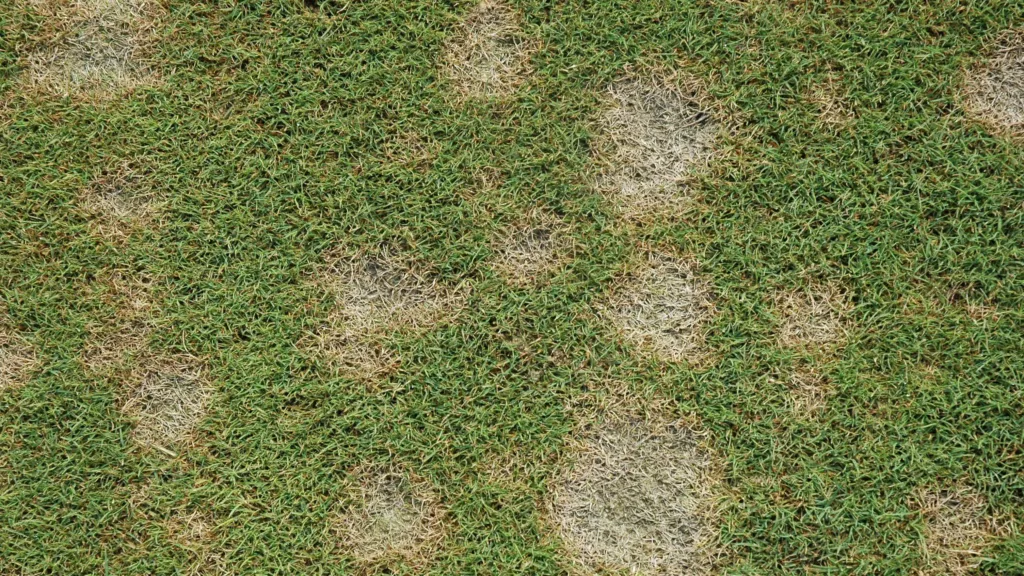
On the flip side, overfertilization is a real problem. Too much nitrogen at once can burn grass. This makes it turn yellow or brown within days of application.
Heavy applications before rain also create runoff, wasting product and potentially causing water quality issues. And pushing rapid growth at the wrong time of year produces weak, disease-prone grass that crashes.
Soil Temperature: The Most Important Fertilizer Factor
Grass roots begin actively absorbing nutrients when soil temperatures reach around 65°F. Below that threshold, fertilizer applied to the ground just sits there or washes away.
Warm-season grasses like Bermuda, Zoysia, and St. Augustine operate in a higher temperature range, thriving between 70 and 85°F. They want feeding during their active growth window, which runs from late spring through summer in most Southern climates.
Cool-season grasses like fescue, Kentucky bluegrass, ryegrass prefer cooler soil in the 60 to 75°F range. They do their best growing in fall and early spring.
You can check soil temperature with a probe thermometer from any garden center. Most people don’t bother, but doing it once changes how you think about timing. You’ll often find that “early spring” by the calendar is several weeks earlier than your soil is actually ready.
There are also visual cues that let you know your grass is ready:
- When grass transitions from winter dull to actively green hue
- When it starts growing fast enough to need mowing
Those are the biological signals that the conditions are right. Dormant grass doesn’t need fertilizer and won’t use it productively.
How Often Should You Fertilize Your Lawn?
Two to four times a year covers most lawns. A minimal approach (fertilizing just once or twice a year) can maintain a decent lawn if you hit the high-value windows. A full four-application seasonal program produces noticeably better results for homeowners who want thick, healthy turf.
Grass type is part of the equation. Warm-season grasses need more frequent feeding during their summer growth period, while cool-season grasses front-load their nutritional needs into fall.
Soil quality plays a role. Poor or sandy soils that don’t hold nutrients well need more frequent replenishment than rich, well-structured soil.
Fertilizer type matters, too. Slow-release formulas feed grass gradually over weeks and need less frequent reapplication than quick-release products.
Your Fertilization Schedule by Season
Early Spring
When grass begins showing active growth and soil temperatures are climbing toward 65°F, an early spring application supports root development coming out of dormancy. Just make sure it’s light. Applying too much nitrogen too early pushes rapid blade growth before the root system is ready to support it.
Skip this application if the ground is still cold or if your grass is still dormant. Fertilizing frozen or dormant grass does nothing.
Late Spring
Six to eight weeks after the early spring application, a late spring feeding supports the lawn’s most vigorous growth period. This is when grass is building density, filling in thin spots, and competing actively against weeds.
A nitrogen-focused fertilizer works well here. Many spring fertilizers also include a pre-emergent weed control component. This combination is especially worth considering if crabgrass or other summer weeds are a recurring problem.
Summer
Summer fertilization is about maintenance. Grass under heat and drought stress is already working hard just to survive. A light application of slow-release fertilizer gives it the nutrients it needs without forcing rapid growth that the plant can’t sustain in high temperatures.
If your lawn goes dormant in summer, skip fertilization entirely until active growth resumes.
Fall
If you’re only fertilizing once a year, this might be when you want to do it. Because fall feeding builds the root system and nutrient reserves that carry the lawn through winter and fuel spring green-up.
The grass isn’t putting energy into visible blade growth at this point. Instead, it’s storing what it needs underground.
Apply in early fall while the soil is still warm enough for active uptake. A second application six to eight weeks later is worthwhile if you’re running a full program.
Stop well before the first frost. Late applications that push blade growth into cold temperatures leave grass vulnerable.
Differences with Grass Types
Warm-season grasses
Bermuda, Zoysia, St. Augustine, and centipede do their growing from late spring through summer. Fertilize every six to eight weeks during that window, taper off in early fall, and stop feeding for the winter.
Applying nitrogen to warm-season grasses in fall stimulates growth that gets killed by the first frost and depletes the root reserves the plant needs for spring recovery.
Cool-season grasses
Fescue, Kentucky bluegrass, and perennial ryegrass run on a different clock. Fall is their primary feeding window. It’s the period of most active growth and root development.
A secondary application in early spring supports the spring growth flush. Avoid heavy fertilization in summer, when cool-season grasses are typically stressed or semi-dormant.
New Lawn vs. Established Lawn
New lawns have different lawn treatment needs for when to fertilize your lawn. When starting from seed, apply a starter fertilizer before or at planting. Starter formulas are higher in phosphorus to support root establishment.
With sod, fertilize shortly after installation once the roots begin anchoring into the soil.
An important note: Avoid weed control products on newly seeded lawns. Pre-emergent herbicides prevent germination, which means they’ll prevent your grass seed from germinating along with the weeds.
Post-emergent products can stress young grass. Wait until you’ve mowed two or three times before introducing any herbicide products.
Established lawns follow the seasonal schedule, adjusted based on what you’re observing. So be sure to look at the growth rate, color, and how the lawn responded to the previous application.
Tips to Get the Application Right
A few practical points that make a real difference:
- Mow one to two days before applying fertilizer so the spreader moves easily and granules reach the soil surface rather than sitting on top of long grass.
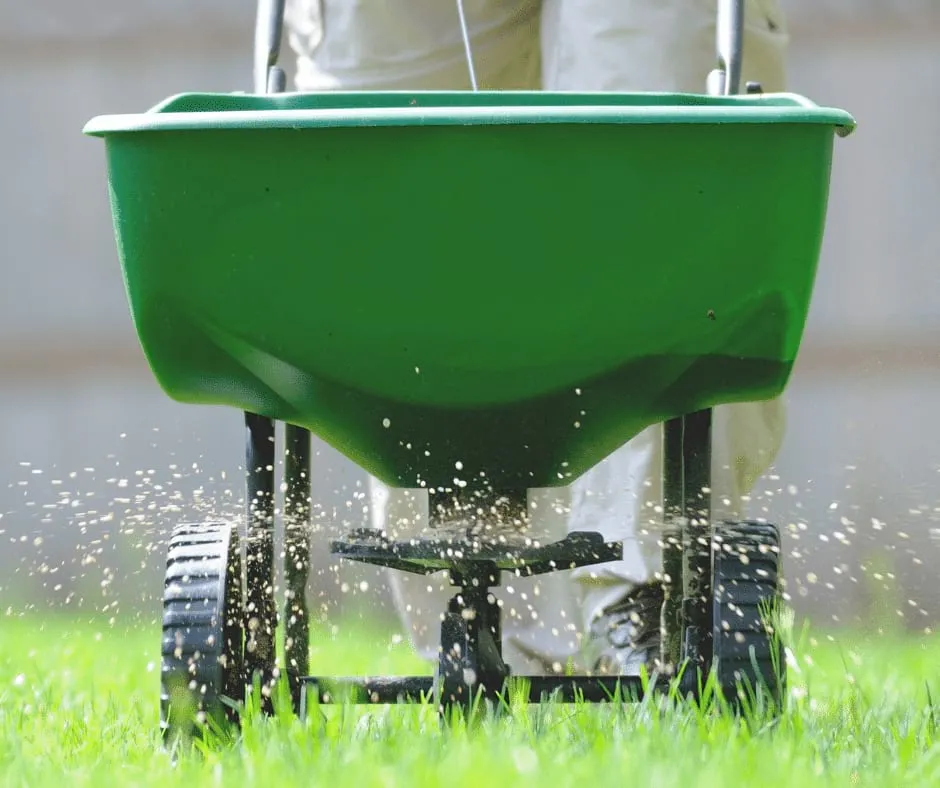
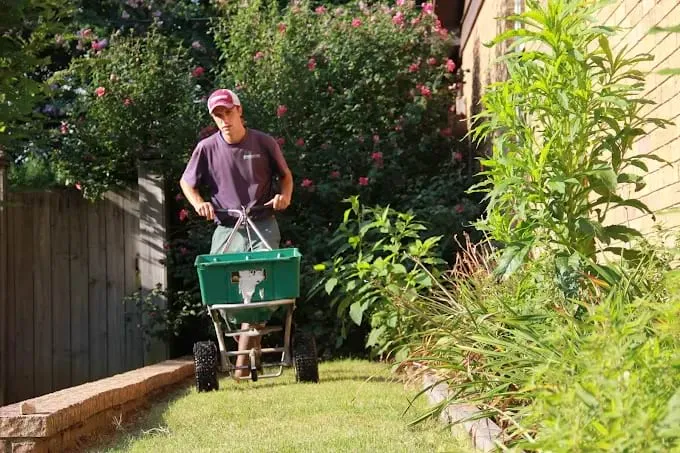
- Use a broadcast spreader for large areas and a drop spreader for areas near beds, water features, or property edges where precision matters.
- Overlap passes slightly to avoid striping. Skipped strips show up as light green lines against a darker lawn within a week.
- After applying granular fertilizer, water lightly to move the product off the blades and into the soil.
- Don’t apply before heavy rain. The irrigation you want is light, and a downpour will wash product off before it’s absorbed.
- Sweep any granules that land on driveways or sidewalks back onto the grass.
4 Common Lawn Fertilization Mistakes
- Fertilizing too early is probably the most common mistake that homeowners make. It feels productive, but it’s essentially just feeding the weeds and risking runoff.
- Overfertilizing, especially with quick-release nitrogen, causes lawn burn. The lawn looks worse after the application than before and takes a few weeks to recover. When in doubt, apply slightly less than recommended.
- Ignoring grass type leads to off-cycle feeding that creates stress rather than supporting growth. Putting a summer fertilizer application on cool-season fescue during a heat wave is a bad idea.
- Applying before forecasted heavy rain wastes product and potentially carries nutrients into storm drains. Check the forecast first.
How to Boost Your Fertilization Results
Fertilization works better alongside a few other practices.
Leaving grass clippings on the lawn after mowing returns nitrogen naturally. A mulching mower essentially provides a low-level continuous fertilizer application throughout the growing season.
Mowing at the right height reduces stress and supports the dense root system that makes nutrients go further.
Deep, infrequent watering rather than shallow daily irrigation encourages roots to grow down toward moisture, increasing the area from which the grass can pull nutrients.
Soil testing, done every two or three years, tells you what your lawn actually needs rather than what you’re guessing it needs. A basic test reveals pH, nutrient levels, and organic matter content.
Lawn Fertilizer FAQs
-
What month is best to fertilize?
For warm-season grasses in Southern climates, late spring (May) and early fall (September) are the two highest-value windows.
For cool-season grasses, September and October are the most important.
-
Can you fertilize too much?
Yes! Burned grass, excessive thatch buildup, and nutrient runoff can all happen because of overapplication.
-
Is it better to fertilize before or after rain?
Light rain after application is ideal. Heavy rain before it soaks in is a problem. So apply on dry grass and water lightly afterward.
-
Should I fertilize if my lawn already looks green?
Looking green doesn’t mean the lawn is well-nourished. Color is one indicator, but growth rate, density, and root depth tell a more complete story.
Trust the Pros at Fairway Lawns!
A good seasonal fertilization program requires attention to timing, grass type, product selection, and application rates. Get those factors right, including when to fertilize your lawn, and the grass responds. Miss the windows or misjudge the amounts and your results won’t be the best.
The team at Fairway Lawns knows grass inside and out. We proudly serve seven states and dozens of communities, ensuring high-quality lawn care and pest control services across the South:
Huntsville AL
Birmingham AL
Jacksonville FL
Conway AR
Springdale AR
Ft Smith AR
Little Rock AR
Augusta GA
Tulsa OK
Columbia SC
Greenville SC
Charleston SC
Knoxville TN
Nashville TN
Memphis TN
Blog Contributor: Dylan Walker
Dylan Walker serves as the Augusta Branch Manager for Fairway Lawns, with 20 years of experience in lawn and landscape care. He holds pesticide licenses in Georgia, South Carolina, and Colorado across turf, ornamental, agricultural weed, industrial and right-of-way, and mosquito categories. He is also a Certified Landscape Technician through NALP and holds a Bachelor of Science in Environmental Horticulture with a Turfgrass Management concentration from Colorado State University.